Vaper's tongue: why your e-liquid lost its flavour
It is a genuinely disorienting experience. The bottle you have been enjoying for weeks suddenly reads as flat, almost mute. You suspect a bad batch, buy the same liquid again, and the flavour is still missing.
The bottle is rarely the culprit. Between a saturated palate, a coil at the end of its life and a wattage that no longer matches the hardware, several suspects hide behind a sudden loss of taste. Vaper’s tongue is the name British vapers give the most common of them, and it is also the easiest to fix.
Vaper’s tongue and the other reasons flavour disappears
When flavour vanishes, the first explanation to consider is a temporary saturation of the palate: the receptors stop registering a profile that has become too familiar. UK retailers and manufacturers alike use the term vaper’s tongue for this, and describe it consistently as temporary rather than damaging.
But it is not the only explanation. A worn coil, a badly set wattage or simple dehydration all degrade how flavour reaches you. In the overwhelming majority of cases the bottle is innocent and the combination of palate, hardware and habit is what has muffled the taste.
Identifying which of the four is at work is the whole exercise, because each one has a different fix and trying them in the wrong order wastes days.
Palate saturation, the classic vaper’s tongue
This is the reflex to check first, and almost every long-term vaper meets it at some point. It is not an injury, it is an adaptation.
Vape the same aroma long enough and the brain begins to filter it out, in the way a perfume disappears after a few minutes in a room. The receptors are not damaged, they have simply stopped flagging something that no longer counts as new information.
The profile then reads as dull without the liquid having changed at all. The effect is sharper with heavily aromatic blends, sweet or strongly mentholated, which push the receptors hardest.
The good news is that it reverses on its own. A few hours or a day away from that particular profile is usually enough, and switching to an opposing flavour family works faster than simply waiting.
A coil at the end of its life
If a pause changes nothing, the hardware becomes the suspect. The coil is the part that ages fastest in any setup, and its decline is gradual enough to go unnoticed.
A worn coil accumulates caramelised residue that masks the aromas and eventually delivers a flat, sometimes faintly burnt taste. Flavour rendition drops progressively, which is why most people only realise how bad it had become after fitting a new one.
Sweet, glycerine-rich liquids accelerate that fouling considerably, and shortfill blends built for lower resistance coils tend to be exactly that. Replacing the coil and priming it properly, by soaking the wick before the first draw, restores a clean taste almost immediately.
Priming matters more than it sounds. British retailers consistently list it as the single maintenance step beginners skip, and a dry first draw on a fresh coil produces a scorched note that follows the coil for the rest of its life.
A wattage that no longer fits
The device setting plays a role that gets ignored constantly. Too many watts or too few, and the flavour retreats either way.
Too much power for the coil dries the wick faster than the liquid can feed it. The taste turns acrid, the aromas disappear, and the sensation is close enough to a burnt hit that people often blame the liquid instead.
Too little power heats the coil weakly, the vapour stays lukewarm and the profile reads as diluted rather than absent. Nothing tastes wrong, it simply tastes like less.
Every coil carries a recommended wattage range printed on it or on the packet. Staying inside that bracket is the condition for a faithful rendition, and the format you bought is a clue: a glycerine-heavy shortfill assumes a lower resistance coil and more power than a 10 ml salt bottle does.
The underestimated role of hydration
The last factor is the simplest and the most neglected. The mouth needs moisture to taste anything at all.
The propylene glycol in e-liquid tends to dry the mouth, which reduces how well flavour compounds reach the receptors. A dry mouth transmits aroma poorly, and the liquid seems washed out as a direct consequence.
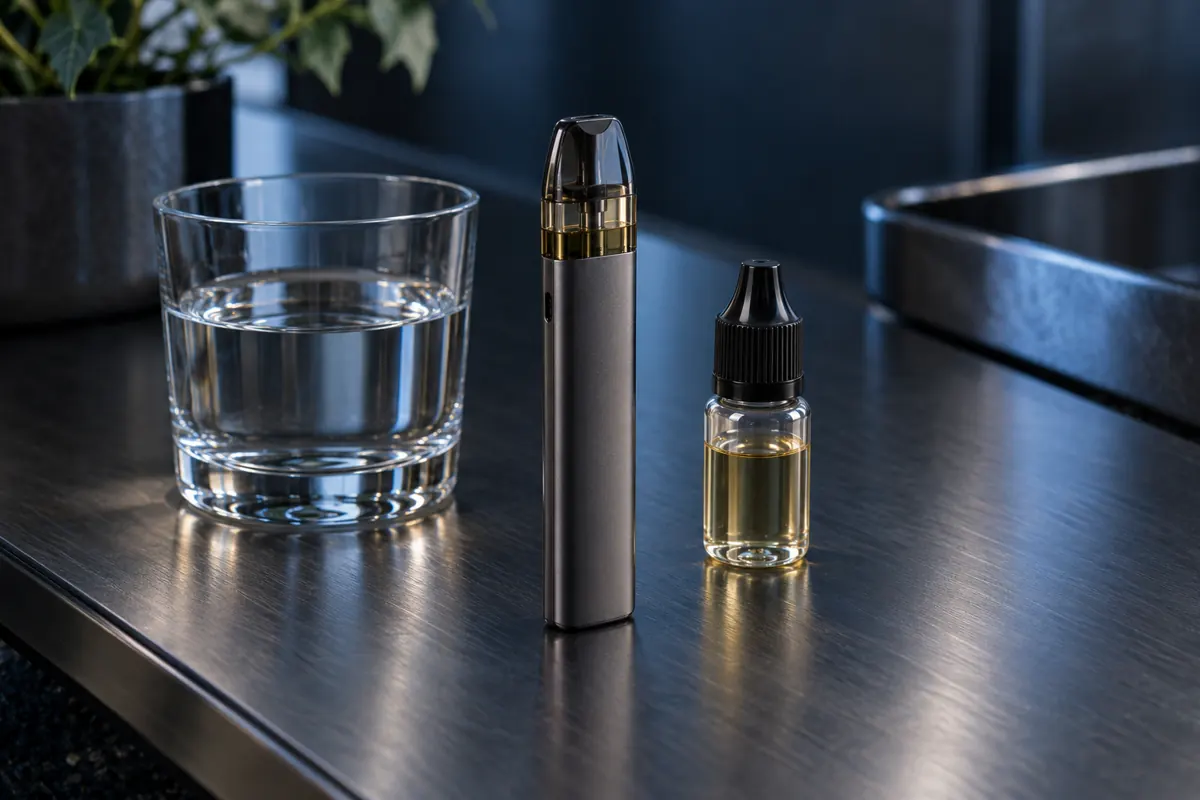
Drinking water regularly through the day maintains that sensitivity. It is an unglamorous habit, but it frequently makes the difference between a profile that feels switched off and one that comes through fully, particularly on bases with plenty of propylene glycol.
Preventing it by varying your palette
The best defence against vaper’s tongue is not curative, it is preventive, and it comes down to one word: rotate. Alternating flavour families stops the receptors settling into a single profile.
Someone who moves between a bright fruit blend and a softer sweet note is recruiting different receptors and pushing the saturation point much further out. Keeping two or three bottles from opposing families and switching through the day is the single most effective routine there is.
It also has a practical advantage on the British shelf. Because 10 ml bottles and shortfills coexist, holding one of each in different families costs nothing in complexity and gives you an instant switch whenever a profile starts fading.
Frequently asked questions
Is vaper’s tongue permanent?
No, it is temporary and reversible. The taste buds are not damaged, only accustomed to a profile. A pause of a few hours, a change of flavour or better hydration is usually enough to restore normal perception.
How long does it last?
It varies with the person and the intensity of the profile involved. Some people recover their sense of taste within hours, others after a full day. Alternating flavours and drinking water shortens it noticeably.
Does changing the coil really bring the flavour back?
Often yes, when the loss came from a fouled coil. A new coil, properly primed, delivers clean aromas from the first draws. If the flavour is still missing on a fresh coil, the cause lies elsewhere.
Can an e-liquid lose its flavour with age?
A badly sealed bottle, or one left in light and heat, can see its aromas weaken. Kept closed and away from sunlight, e-liquid holds its profile well beyond opening. A sudden loss of taste rarely comes from age.
Do I need to stop vaping to fix it?
No, changing flavour and staying hydrated is normally enough. Moving to an opposing aroma family wakes different receptors and often restores taste without any other measure at all.
Getting the flavour back, methodically
When a bottle stops tasting of anything, the answer is rarely a new bottle. It sits in the palate, the coil, the wattage or the water you have not been drinking, and working through those four in order settles it almost every time.
Start with a day on a different family, then look at the coil, then check the wattage against the range printed on it. If a balanced base is not part of your setup, that is worth reviewing too, because a very thick liquid on a small device produces its own kind of flavour loss.
And to stop vaper’s tongue settling in at all, nothing beats a varied palette where flavour families take turns keeping your attention awake, draw after draw.
Editorial content for adult readers only. Vaping products usually contain nicotine, a substance that causes addiction. Not for sale to under-18s in the United Kingdom. This article is not a buying recommendation.